The Ceiling Showdown: The Practical (and Aesthetic) Benefits of Semi-Flush Mount Light Fixtures Over Pendants
We have all fallen into the Pinterest trap. You are scrolling through beautifully curated interior design feeds, and your eyes land on a breathtaking room. Hanging gracefully from an impossibly high ceiling is a massive, sculptural pendant light. It looks dramatic, elegant, and effortlessly high-end. Intrigued, you purchase a similar hanging fixture, install it in your own home, and wait for the magic to happen.
Instead, reality sets in.
Suddenly, your living room feels oddly cramped. Your taller friends instinctively duck when walking through the center of the room. Every time you open the balcony window, the light fixture sways like a pendulum. Worst of all, despite having a powerful bulb installed, the upper corners of your room remain cast in deep, moody shadows, making the entire space feel smaller than it actually is. This frustrating scenario highlights the ultimate design challenge: How to make a small space look more spacious through lighting layout.
This is the classic conflict between editorial design and livable architecture. While long, cascading pendant lights steal the spotlight in magazines, semi-flush mount light fixtures are the quiet overachievers of the real world. They bridge the gap between ordinary, uninspired flush mounts and low-hanging pendants, offering a masterclass in structural practicality, light distribution, and spatial safety.
If you are currently torn between a pendant and a semi-flush mount for your next home refresh, let’s unpack the architectural, physical, and practical reasons why opting for a semi-flush mount might be the smartest design move you make.
1. The Physics of Light: Ambient Dispersion vs. Focused Cones
To understand why semi-flush mounts excel in everyday living spaces, we first need to look at how light interacts with three-dimensional space. Not all light is distributed equally, and the structural design of a fixture dictates exactly where those lumens travel.
The Downward Cone Problem of Pendants
Pendant lights are inherently directional. By design, they feature a canopy, a long cord or stem, and a shade that houses the bulb. Because they hang relatively low, their primary job is to provide task lighting. They cast a concentrated, downward pool of light. This is fantastic when you are chopping vegetables over a kitchen island or trying to read a menu at a restaurant table.
However, when you use a low-hanging pendant as the primary light source for an entire room, you encounter a phenomenon known as spatial compression. Because the light is directed down toward the floor, the top third of your room—the ceiling and the upper walls—remains in shadow. Psychologically, human brains perceive spaces as smaller and more restrictive when ceilings are dark.
The "Ceiling Bounce" Solution
A semi-flush mount fixture solves this problem through clever structural engineering. A semi-flush mount is suspended by a short stem, usually creating a strategic gap of 10 to 20 centimeters between the ceiling plane and the light source.
This tiny architectural gap changes everything. When the bulb illuminates, the light doesn't just shoot downward; it escapes upward and outward, hitting the ceiling surface first. The ceiling then acts as a giant, natural reflector shield, bouncing a soft, highly diffused, and even glow across the entire room. This is known as ambient illumination. To fully optimize this setup, it is also essential to consider the Color temperature and brightness guidelines for all types of rooms. By lighting up the ceiling plane, a semi-flush mount visually erases shadows, pushes the boundaries of the walls outward, and makes the entire room feel significantly airier and more spacious.
Design Tip: If you want to make a compact room feel larger, don't just buy a brighter bulb. Change the direction of the light. A semi-flush fixture utilizes the architecture of your home to maximize its own efficiency.
2. The Geometry of Headroom: Sightlines and Spatial Ergonomics
Beyond the way light travels, we must consider the raw mechanics of how humans move through a room. Every residential space has an invisible grid of structural boundaries and human traffic pathways, known in the design world as circulation zones.
The Realities of Standard Layered Space
In most modern homes and apartments, standard ceiling heights range between 2.4 meters and 2.7 meters (approximately 8 to 9 feet). If you hang a traditional pendant light in a high-traffic area—such as the center of a living room, an entryway, or a hallway—you run into immediate clearance issues.
Interior design guidelines state that the bottom of a hanging light fixture should sit at least 2.1 meters (7 feet) above the finished floor to allow people to walk underneath safely. If your ceiling is 2.4 meters high, and you install a pendant with a standard 60-centimeter drop, your fixture is now hanging at 1.8 meters. You have officially created a head-bumping hazard.
Eliminating Visual Noise
Even if you don't physically collide with a low-hanging light, it can still cause visual clutter. When you walk into a room, your eyes prefer clean, uninterrupted sightlines. Long cords, heavy chains, and low-slung shades cut right through the middle of a room's horizon line. In small or mid-sized spaces, this fragments the visual plane, making the room look busy and disorganized.
Semi-flush mounts stay securely above the human clearance zone. They keep the lower and middle thirds of your room completely open, drawing the eyes upward to appreciate the volume of the space rather than cutting it in half.
3. Maintenance, Safety, and the Hazards of Daily Life
When choosing lighting, it is easy to forget about the unglamorous aspects of homeownership: cleaning, home maintenance, and general wear and tear. This is an area where the structural stability of a semi-flush mount completely outshines the delicate nature of a hanging pendant.
- The Wind and Motion Factor: If you live in a home with strong natural cross-breezes, or if you like to run ceiling fans, pendants can be problematic. Because they are suspended by flexible cords or chains, they are highly susceptible to shifting air currents. A swinging pendant is not only visually distracting, but it also places unnecessary stress on the ceiling junction box. Semi-flush mounts, anchored rigidly by short metal or wood stems, remain completely stationary regardless of airflow.
- The Dust Trap Dilemma: Because pendants hang lower and are closer to eye level, any layer of dust, pet dander, or fingerprints on top of the shade becomes immediately apparent to you and your guests. Furthermore, because they hang freely, wiping down a pendant often involves holding the fixture steady with one hand while trying to clean it with the other—a recipe for accidental damage. A semi-flush mount collects less airborne dust because it sits higher up, and its rigid mounting makes it vastly easier to wipe clean safely.
- Child and Pet Safety: In playrooms, bedrooms, or areas where pets climb (like near cat trees or tall bookshelves), low-hanging cords are an accident waiting to happen. Whether it’s a stray pillow toss or a curious pet jumping for a dangling cord, pendants are vulnerable to high-energy households. A semi-flush mount stays entirely out of harm's way.
4. Case Study: The Twin-Size Showdown
To truly understand how these principles play out in practice, let’s look at a fascinating design paradox. What happens when two light fixtures share almost identical physical footprints, but utilize completely different mounting styles?
Let’s examine two expertly crafted fixtures to see how their structural differences dictate their ideal placements in a real home.
The Competitors At A Glance
| Design Metric | The Semi-Flush Choice | The Pendant Choice |
|---|---|---|
| Product Name | Sophie Modern Round Macaron Wood Grain Ceiling Light | Coraline Retro Wabi-Sabi Travertine Dome Pendant Light |
| Width | 15 cm | 15 cm |
| Height / Body Drop | 19 cm | 17 cm (plus adjustable hanging cord) |
| Primary Material | Warm Wood Grain & Macaron Finished Metal | Natural Travertine Stone |
| Ideal Lighting Role | Widespread Ambient Room Illumination | Focused Task & Architectural Accent |
Analysis: Sophie Modern Round Macaron Wood Grain Ceiling Light
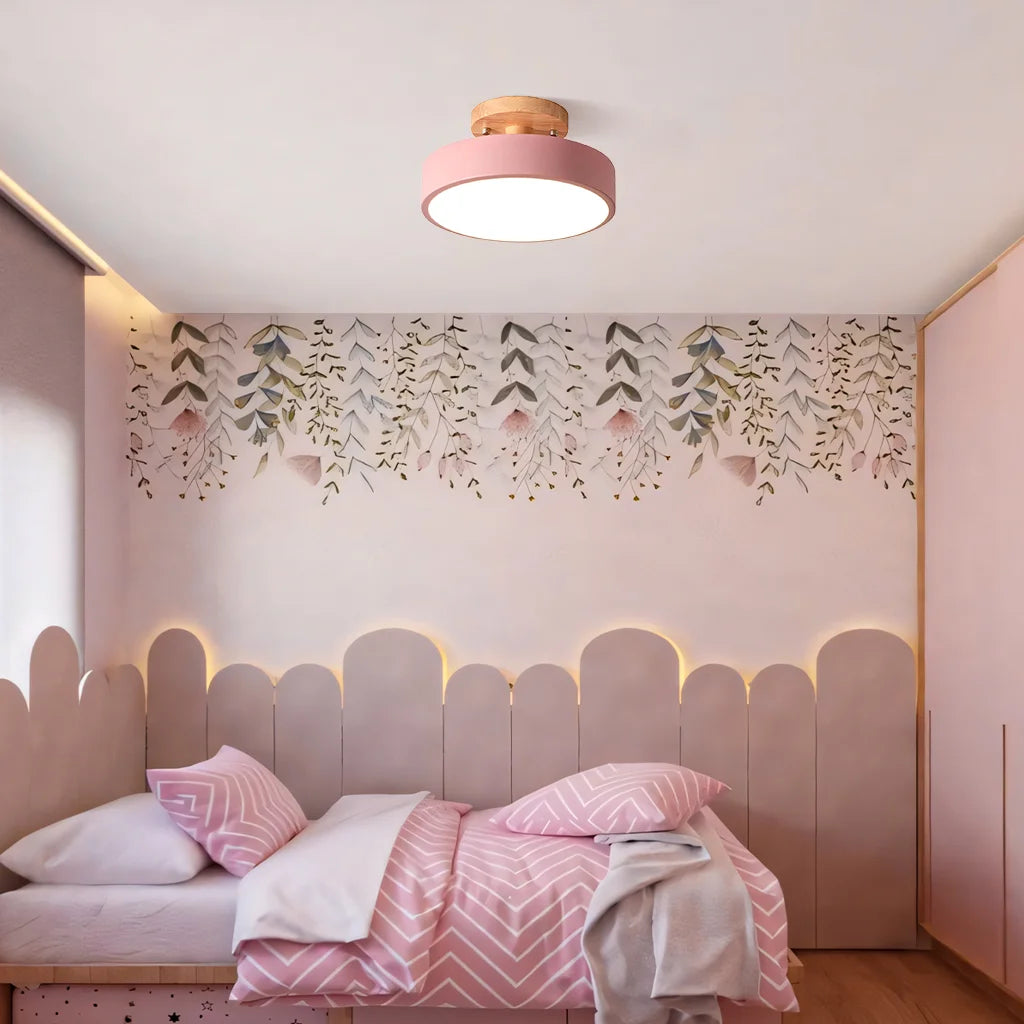
The Sophie Modern Round Macaron Wood Grain Ceiling Light is the quintessential example of a modern semi-flush mount acting as a space-optimizer.
With a width of 15cm and a total height of just 19cm, this fixture is incredibly compact. However, because it utilizes a semi-flush mount installation, it functions beautifully as a primary light source for high-frequency zones.
The design features a brilliant combination of playful macaron styling and a warm, organic wood grain base. In traditional flush mounts, the close proximity to the ceiling can sometimes feel clinical or cold. The Sophie light counters this psychological effect through its materials. Wood grain naturally softens light, giving the "ceiling bounce" effect a cozy, sun-drenched quality. It is an ideal solution for:
- Narrow Hallways & Entryways: Where doors swing open and clearance is non-negotiable.
- Walk-In Closets & Dressing Rooms: Where you need high visibility without an intrusive fixture blocking top shelves.
- Japandi or Scandi-Style Bedrooms: Where a clean, minimalist aesthetic demands that visual clutter be kept to an absolute minimum.
Analysis: Coraline Retro Wabi-Sabi Travertine Dome Pendant Light
Now, let’s look at its architectural counterpart: the Coraline Retro Wabi-Sabi Travertine Dome Pendant Light.
At 15cm wide and 17cm high, its core fixture body is actually slightly smaller than the Sophie. Yet, because it is a pendant light, its interaction with a room is entirely different. Crafted from genuine travertine stone, the Coraline embodies raw, tactile minimalism and rustic Wabi-Sabi charm. The solid, opaque dome shape means that light cannot escape upward or outward; it is channeled exclusively downward in a concentrated beam.
Because it hangs from an adjustable cord, you wouldn't use the Coraline to light up an entire entryway or a high-traffic living room. Instead, it is designed to create an intimate, localized mood. It excels when dropped low over specific, dedicated surfaces:
- Bedside Nightstands: Replacing traditional table lamps to free up surface space.
- A Cozy Reading Nook: Creating a warm, dedicated sanctuary of light over an armchair.
- A Breakfast Bar or Kitchen Island: Hung in a linear series of two or three to anchor the dining zone.
The Takeaway From the Comparison
The comparison between these two fixtures proves a fundamental interior design law: The success of a light fixture is determined by how well its mounting style matches the function of the zone it occupies.
If you tried to put the Coraline pendant in the middle of a busy hallway, it would cut off the space and cast dramatic, impractical shadows on the walls. Conversely, if you put the Sophie semi-flush mount directly over a moody reading corner, it would diffuse too much light across the ceiling, destroying the intimate, cozy atmosphere you were trying to cultivate.
5. Dismantling the Myth: The Modern Aesthetic Rebrand
For years, semi-flush mount fixtures suffered from a bad reputation. Many homeowners associated them with cheap builder-grade alternatives—often colloquially referred to by designers as the dreaded, ubiquitous "boob light" glass bowls of the 1990s and early 2000s. People chose pendants simply because pendants were the only fixtures that felt contemporary, artistic, and stylish.
Thankfully, that era is entirely over. Modern lighting industrial design has undergone a massive evolution. Today, semi-flush mounts are treated as genuine pieces of architectural sculpture. Designers are utilizing premium materials—like matte-finished macaron metals, organic timbers, hand-blown milk glass, and brushed brass—to ensure that these compact fixtures command attention for their beauty, not just their utility.
A well-chosen semi-flush mount doesn’t scream for attention by hanging low into your physical reality. Instead, it elevates the room quietly, serving as a subtle design punctuation mark that respects the volume, airiness, and natural flow of your home.
The Ultimate Decision Matrix: Which One To Choose?
If you are standing in an empty room trying to make your final choice, ask yourself these three simple structural questions to guide your purchase:
By understanding the unique, practical powers of the semi-flush mount, you can stop designing for an imaginary magazine cover and start designing for the real, beautiful way you live every single day. Balance your room, protect your sightlines, and let your ceilings breathe.
Frequently Asked Questions (FAQ)
Q1: Can a semi-flush mount light fixture make a small room look bigger?
Yes, absolutely. Because semi-flush mounts leave a small gap between the fixture and the ceiling, light throws upward and outward (ceiling bounce). Illuminating the ceiling plane removes dark shadows and visually opens up the vertical borders of the room, making a small space look airier and larger.
Q2: What is the ideal ceiling height clearance for a hanging light fixture?
Standard interior design guidelines dictate that the bottom of any light fixture hanging in an open walking zone or corridor must maintain a minimum clearance of 2.1 meters (7 feet) from the floor. Semi-flush mount fixtures easily preserve this safe space on standard 2.4m to 2.7m ceilings.
Q3: Are pendant lights and semi-flush mounts interchangeable?
Not naturally. They serve different lighting functions. Pendant lights provide localized, directional task lighting (best over kitchen islands, dining tables, or desks). Semi-flush mounts provide comprehensive, wide-spread ambient lighting ideal for open areas, pathways, and full-room coverage.
Q4: Are semi-flush mounts out of style?
Not anymore. While old designs were basic, contemporary semi-flush mounts feature high-end architectural styling, natural woods, premium stones like travertine, matte macaron finishes, and luxurious metals, making them a premium design asset.