Small Bedroom Lighting Ideas: Create a Welcoming Atmosphere in Just a Few Square Meters
Small bedrooms are frequently misunderstood. In interior design circles, they are often labeled as "cramped," "challenging," or "boxy." However, when approached with the right spatial philosophy, a compact bedroom has the potential to become the most comforting, restorative room in an entire home. The secret to unlocking this potential does not lie in knocking down walls or purchasing multi-functional, folding furniture that is frustrating to use. Instead, the ultimate tool for spatial transformation is strategic, high-quality lighting design.
In a limited space, lighting does far more than just illuminate a dark room after sunset. When planned correctly, light visually pushes back boundaries, tricks the eye into perceiving higher ceilings, and eliminates the dark corners that make a room feel restrictive. Most importantly, it creates an emotional shift, turning a tight layout into an intimate, high-end sanctuary.
To achieve this, we must move away from old-school lighting habits and learn how to manage light within just a few square meters.
| Lighting Layer | Role in a Small Bedroom | Primary Source Examples |
|---|---|---|
| Ambient Lighting | The foundational glow; dissolves room boundaries and dark corners. | Flush or semi-flush ceiling mounts with advanced diffusers. |
| Task Lighting | Functional illumination focused entirely on specific activities. | Wall-mounted swing-arm sconces, slender hanging mini-pendants. |
| Accent Lighting | The mood-setter; creates visual depth and the illusion of extra space. | Hidden low-voltage LED strips behind headboards or beneath bedframes. |
By understanding how these layers interact, you can stop treating your bedroom as just a sleeping box and start viewing it as a dynamic, layered landscape of light. As we dive into how to achieve the perfect layered lighting solution at home, let's explore the core techniques required to execute this layout flawlessly.
1. The Ceiling "Invisible Trick": Why Material and Diffusion Dominate Compact Spaces
When people attempt to fix a dark, small bedroom, their first instinct is often to install the brightest bulb possible into their existing central ceiling fixture. This approach usually backfires. A harsh, exposed light source hanging from the middle of a small room creates intense downward shadows. It accentuates the sharp edges of your furniture and leaves the perimeter of the room in darkness, making the walls feel as if they are closing in on you. This phenomenon is known as "shadow entrapment."
To counter this, your primary ambient light source needs to perform an architectural magic trick: it must distribute light so evenly that the boundaries of the ceiling seem to dissolve. This is where the choice of fixture material becomes critical.
Instead of heavy, industrial metal frames or clear glass globes—which project glare and sharp shadows—compact bedrooms thrive when paired with advanced, light-diffusing materials. Acrylic materials, particularly those engineered with structural textures, act as thousands of micro-prisms. Rather than throwing a direct, unfiltered beam downward, they scatter the light horizontally and softly across the entire ceiling plane.
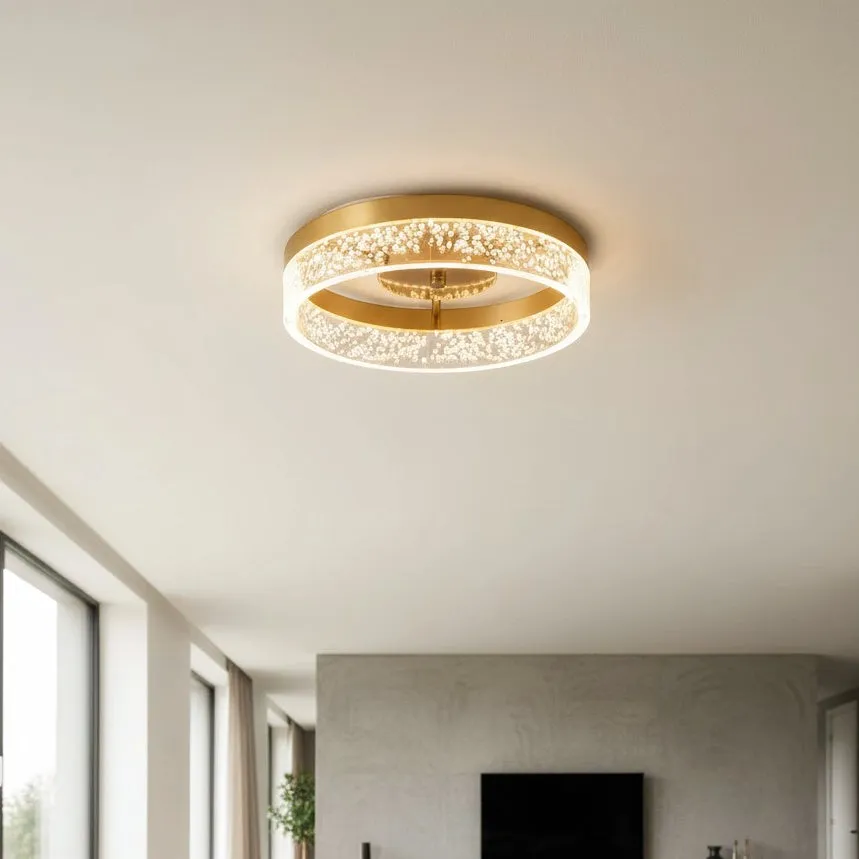
This design philosophy is perfectly embodied by the Everly Modern Bubble Acrylic Round LED Ceiling Light. From a spatial design perspective, this fixture solves two fundamental small-room problems simultaneously:
- Low-Profile Vertical Clearance: Hanging pendants or bulky chandeliers cut a small room in half horizontally, instantly making the ceiling feel lower. The Everly light features a sleek, flush-to-ceiling circular design that preserves valuable vertical space, keeping the visual plane completely unobstructed.
- The Power of Bubble Acrylic: The unique textured bubble acrylic shade catches the internal LED light and softens it into a dreamy, cloud-like luminescence. Because the light is diffused uniformly outward, it reaches the highest corners of your walls, wiping away the dark perimeters that contract a room's perceived size.
By treating your ceiling light as a tool for uniform diffusion rather than raw brightness, you establish a foundational glow that mimics natural daylight, instantly relaxing the eyes and setting a serene tone for the entire space.
2. Freeing Up the Bedside: The Architecture of No-Footprint Task Lighting
Once your foundational ambient light is established, the next challenge is task lighting—specifically, your bedside reading lights. In a spacious master suite, massive nightstands topped with oversized ceramic table lamps look beautiful. In a room wrapped within just a few square meters, however, that setup is a design disaster.
A standard table lamp typically consumes up to 50% of a small nightstand's surface area. When you add a phone charger, a book, and a glass of water, the surface becomes instantly cluttered. In a compact bedroom, physical clutter translates directly to visual stress, sabotaging the welcoming, peaceful atmosphere you are trying to build. The solution is simple: lift your lights entirely off the furniture.
Option A: Architectural Wall Sconces
Mounting fixtures directly to the wall is the most effective way to reclaim your bedside surfaces. For small bedrooms, choose sconces featuring slender, adjustable swing arms. This allows you to pull the light close for reading, and push it flat against the wall when you are finished.
Design Tip: To avoid glare when lying down, position your wall sconces roughly 60 to 75 centimeters above the top of your mattress. This ensures the light pool hits your pages perfectly without exposing your eyes directly to the bulb.
Option B: Dropped Mini-Pendants
If you cannot or do not want to drill deep into your walls for sconces, look to the ceiling once more. Dropping a pair of micro-pendant lights from above down to the sides of your bed is an excellent designer trick. Because these fixtures use slender cords or rods, they create strong vertical lines. These lines force the human brain to focus on the height of the room rather than the narrow floor space, tricking the subconscious into believing the room is substantially grander than its actual square footage.

3. The Illusionist’s Playbook: Layering Reflection and Hidden Low-Level Light
To truly replicate the atmosphere of a boutique luxury hotel within a modest footprint, you must incorporate accent lighting. While ambient light lets you navigate the room and task light lets you read, accent lighting is what creates deep emotional comfort. It focuses on casting light from unexpected angles to blur the true physical dimensions of the space.
The Mirror Matrix
One of the oldest tricks in interior design is using mirrors to double visual space, but few people consider how mirrors interact with artificial light. Never place a mirror directly opposite a bare, bright lightbulb, as this creates a distracting double-glare that causes eye strain.
Instead, position an arched or full-length floor mirror adjacent to a softly diffused light source, such as your central acrylic ceiling fixture. When the gentle, scattered light hits the glass surface—a setup that beautifully maximizes the Color temperature and brightness guidelines for all types of rooms—it bounces back into the room at an angle, creating an illusion of depth that makes it feel as though there is another room sitting right beyond the wall.
Low-Level Floating Glows
Another highly effective way to expand a room is to place light where it traditionally does not belong: near the floor. Human eyes are accustomed to light coming from above (the sun, standard ceiling fixtures). Introducing low-level lighting disrupts our spatial expectations, making boundaries feel less rigid.
- Under-Bed LED Strips: Affix a flexible, dimmable LED strip underneath your bed frame, setting it back a few centimeters from the edge. When turned on in the evening, the under-bed glow creates a "floating" optical illusion. By illuminating the floor space that is normally lost to heavy shadows, the bed feels weightless, and the floor plane feels wider.
- Behind-Headboard Backlighting: If your bed frame allows for it, run a low-voltage light strip along the back of your headboard, facing the wall. This casts a soft wash of light upward behind your head. It separates the bed from the wall structurally, adding an extra layer of depth to an otherwise flat vertical surface.

Conclusion: Crafting Your Cozy Cocoon
Designing an exceptional small bedroom is not about trying to make it look like a sprawling, cavernous hall. It is about leaning into its natural compact proportions and engineering a sense of safety, warmth, and ultimate comfort—a true "cozy cocoon."
By moving away from heavy fixtures, prioritizing space-saving layouts like sconces, and utilizing advanced materials that banish harsh perimeter shadows, you can easily shift the entire mood of your home.
Ready to begin your compact room transformation? Start with your largest visual canvas: your ceiling. Elevate your space instantly by exploring the Everly Modern Bubble Acrylic Round LED Ceiling Light, and discover how easily a few square meters can become your favorite escape.